







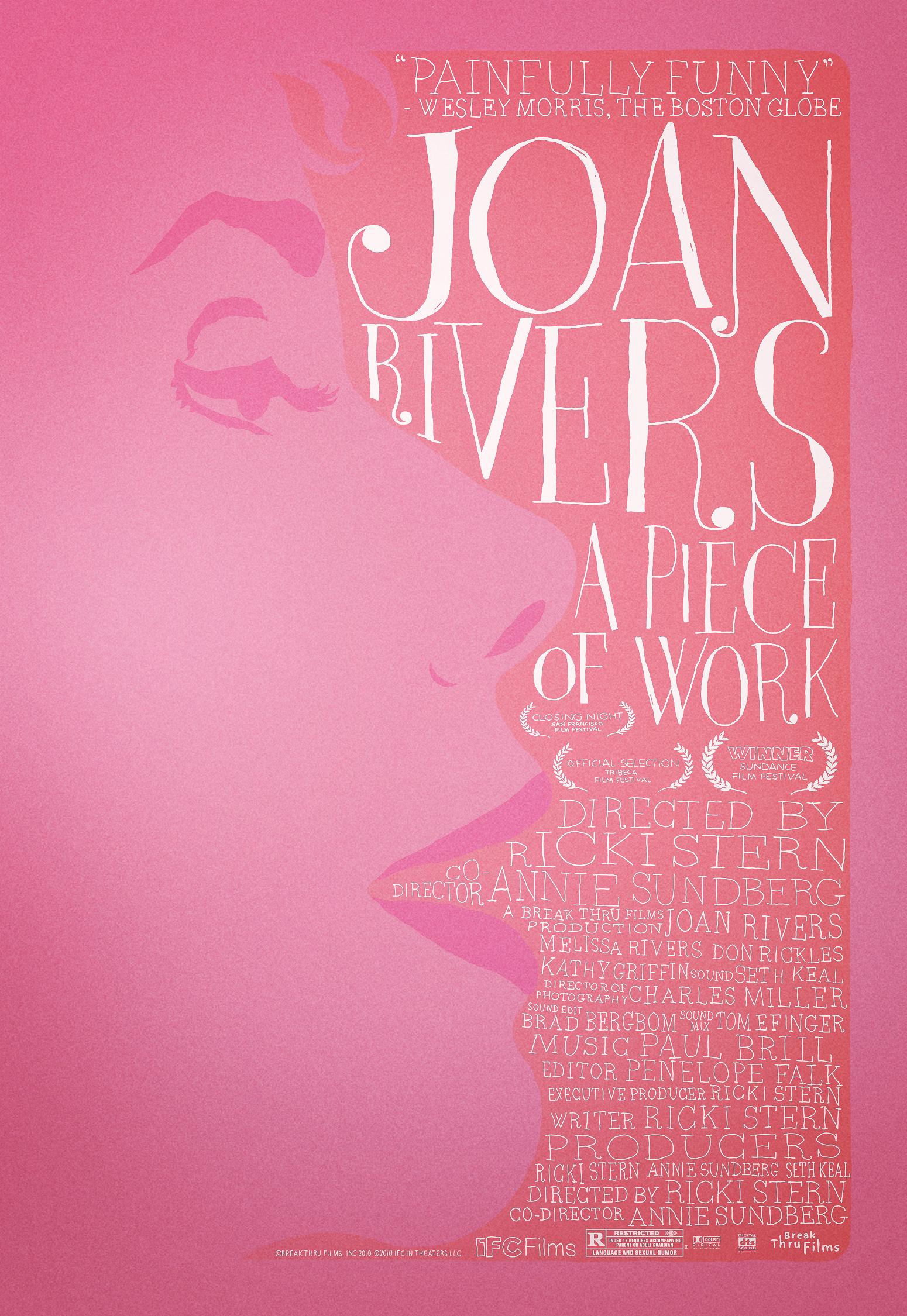
Joan Rivers knows exactly how the public views her and all the surgeries have helped keep her chin up through the years. It is the idea of expressing her fears through comedy and as therapy and struggling to maintain her role as a public figure that has fueled River’s career for nearly forty years. Joan Rivers: A Piece of Work reveals one year in the life of an icon that seems to pop-up every now and again, and how she holds on to each moment as she ages and resists retirement.
Rivers’ personal assistant flips through the appointment calendar showing the blank spaces available in the calendar. Joan Rivers has been in the business for forty years and getting money making appearances and gigs is still a difficult task. Rivers recounts that leaving the side of Johnny Carson, the man who gave her the leg up she needed, was the single mistake of her career, keeping her merely on the surface of celebritism.
She continues to fight, not just fighting to stay within the public’s consciousness and to acquire new appearances, but to struggle for the ability to express herself and her dirty, filthy style, which in modern times, can only be compared to Sarah Silverman. Her forceful comedy routine is what initiated her fame, and after forty years she has not let up.
A Piece of Work states its purpose immediately to explain that Rivers’ career and beauty has been a roller coaster ride, but she is willing to play the relentless game. She continuously believes that she has been blacklisted from certain entertainment circles and any organization that aligns itself with NBC. Her guilt in snubbing the man who told her “you’re gonna be a star” has affected her career ever since.
Many times in the documentary, Rivers explains that she needs to tell jokes. An argument between her and a audience member about a joke; Rivers defends her joke and the need to let out what everyone needs to hear. Her need to perform and soak up the spotlight explains her desire to never retire. At seventy-five her voice remains youthful and upbeat, but her swagger and slouch shows her true age, even behind the surgeries.
Rivers recognizes that she is a part of a niche trend of using the public desire for nostalgia and this nostalgia is the catalyst that keeps her relevant. Winning Celebrity Apprentice, reluctantly ‘honored’ with a Roast, and an appearance at a George Carlin repeatedly boosts her back into the public’s consciousness. The random fan shows up now and again, each time re-affirming River’s place in popular culture and assuring her that she does indeed have an audience.
A Piece of Work is another account of how the current trends of nostalgia and reality programming have given former idols and media mongrels another chance at their fifteen minutes. Perhaps the most revealing aspect of A Piece of Work is how Rivers’ comedy offers a much higher quality than her non-stand-up appearances and gigs. Could Carson’s rage been justified in the idea that Rivers should have kept standing up to the man with her comedy, instead of giving in? Between the lines of A Piece of Work is this implication.


